
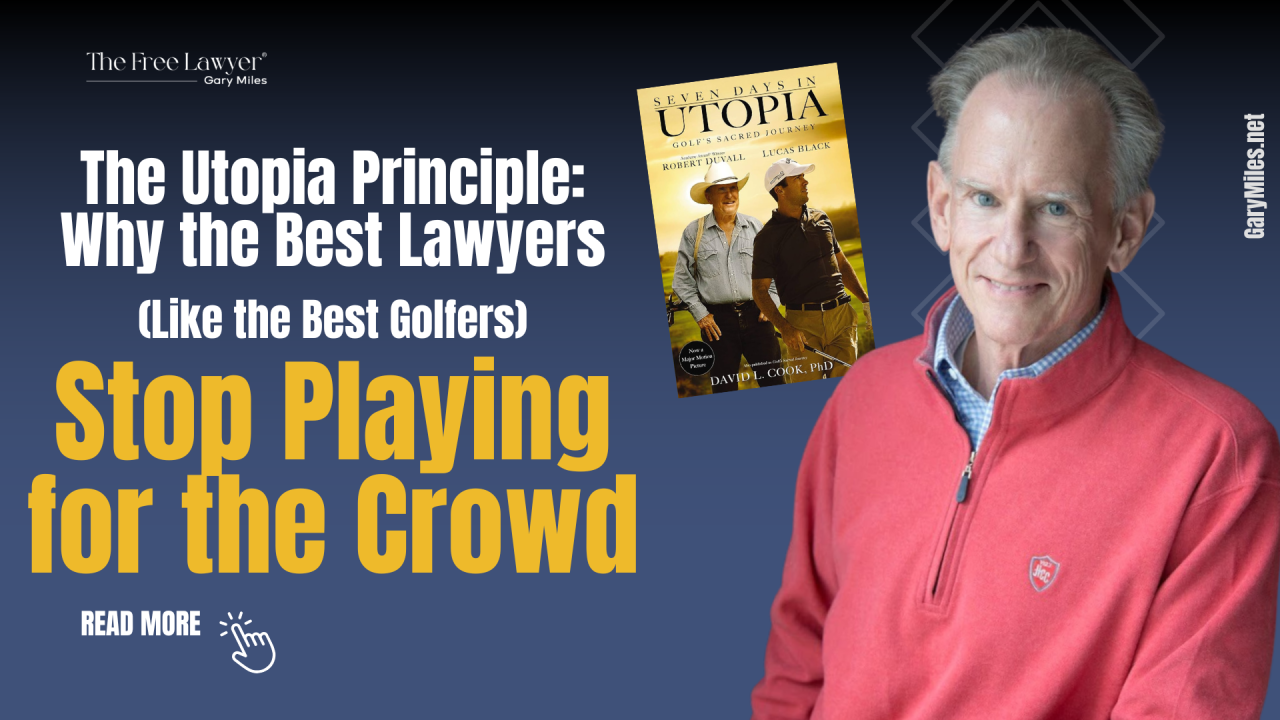
The Utopia Principle: Why the Best Lawyers — Like the Best Golfers — Stop Playing for the Crowd
A young golf professional stands over a shot that should be routine. He’d been leading the tournament earlier in the day. But now his playing partner is visibly irritated, the group behind them is pushing, and every swing feels like it’s being watched through a magnifying glass. He tries to thread the needle one more time — and the ball ricochets off an oak into deep grass. Panic sets in. The collapse that follows is total and very public. So he does what many successful lawyers would do — he flees. Drives aimlessly out of San Antonio with no destination, nothing but the weight of a performance that was supposed to define him. Until he hits a fork in the road and turns left toward a tiny Texas Hill Country village called Utopia.
That’s the opening of Dr. David Cook’s remarkable book, Golf’s Sacred Journey: Seven Days at the Links of Utopia. I picked it up at my home here in Pinehurst, North Carolina — surrounded by some of the most iconic golf courses in the world — and I was struck by how powerfully it speaks to what I see every day as I coach successful lawyers and high-performing attorneys. This book isn’t really about golf. As Cook himself put it, the deeper message is about how we travel through life and how we touch others, which is the true measure of success.
The lessons a broken golfer learns in seven days from an eccentric Texas rancher are the same lessons that can liberate a successful lawyer who’s spent decades building a prison out of their own achievements.

When the Performance Fails, the Person Fails
Cook designed his unnamed golfer around a pattern he’d seen in thousands of elite athletes he’d counseled over decades as one of the country’s top performance psychologists. The pro’s entire sense of self is tied to his scorecard, his father’s approval, and the gallery’s reaction. His emotions rise and fall with his scores. When the performance fails, the person fails. There’s nothing underneath to catch him.
The External Authority Trap
I see this pattern constantly with the successful lawyers I coach. These are attorneys who’ve built impressive books of business, earned the respect of judges and peers, and won cases that genuinely matter. On paper, they’ve won. But internally, they’re running on a treadmill of external validation that never stops. The next verdict. The next client. The next accolade. Always one more performance away from feeling like they’ve actually arrived.
I call this the External Authority Trap. When your confidence depends on the verdict, the client’s praise, or what your peers think of you, you haven’t built confidence at all. You’ve built dependency. And dependency, no matter how well it’s dressed, is still a prison.
A Managing Partner’s Private Battle
One managing partner I work with — a thirty-year veteran who built his firm from the ground up — has been controlled by the thoughts of others for years despite his remarkable success. The constant inner interrogation runs like a ticker tape through his mind every single day: What do they think of me? What am I if I don’t win? The turning point came during a conversation when he finally admitted he couldn’t remember the last time he made a professional decision without first calculating how it would look to others.
Cook captures this perfectly through what he calls the “wrong scoreboard.” The golfer’s self-worth is based entirely on the score he shoots, which, Cook observed, is like many people in our culture whose worth, value, and identity are based on how they perform. That’s the same wrong scoreboard my client kept for three decades. He’s now doing the hard work of changing what he measures.

The Fork in the Road and the Mentor You Don’t See Coming
Sometimes, the most important guidance in your career arrives in the most unexpected packaging.
The golfer ends up in Utopia — a real town of 373 people nestled among live oaks along the Sabinal River. There he meets Johnny Crawford, an eccentric rancher who owns a humble nine-hole course called the Links of Utopia. Johnny isn’t a sports psychologist. He’s a man who, as Cook described, lived in a simple place but had extraordinary insight and time to invest himself in the life of another who was lost on his journey. Johnny proposes a seven-day journey to rebuild not just the golfer’s swing, but his life — emphasizing truths over golf tradition, conviction in one’s purpose, and trusting something deeper than the scoreboard.
Lessons That Don’t Look Like Lessons
What makes Cook’s book so powerful is that Johnny’s teaching method is entirely unconventional. Each chapter unfolds a distinct day of training, and none of it looks like golf instruction.
In “Shadow-Casting,” Johnny takes the golfer fly-fishing on the Sabinal River — not to relax, but to teach him to read subtle signs, exercise patience, and avoid taking the reactive “bait” that pulls you off course emotionally. How many successful lawyers react to every critical email, every partner’s offhand comment, every perceived slight — swallowing the bait and losing their rhythm in the process?
In “Signing a Masterpiece,” Johnny has the golfer paint a canvas. The lesson is about learning to embrace and sign your own authentic work without pretense or imitation. If you don’t choose to paint a masterpiece, you’ll spend your life mired in stick-figure outcomes. I think of the attorneys I’ve coached who spent so many years mirroring what the firm expected of them that they forgot what their own authentic practice even looked like.
In “Tradition vs. Truth,” Johnny champions unconventional approaches over rigid convention — passion for truth over rote tradition. This chapter speaks directly to the legal profession, where so many successful lawyers keep doing things a certain way simply because that’s how it’s always been done. Johnny’s message is clear: a respect for tradition is fine, but a passion for truth is better.
In “Hickory Sticks,” vintage clubs force the golfer to strip away ego and return to fundamentals. No fancy equipment to hide behind. Just the basics — humility, focus, and honest self-assessment. It reminds me of lawyers who keep adding staff, technology, and complexity to their practice, when what they actually need is to return to the fundamentals that led them to become lawyers in the first place.

When Successful Lawyers Try to Fix the Wrong Problem
This is exactly what happens with accomplished attorneys who feel trapped. They try to solve an identity problem with logistical tools. They hire more staff. They block their calendars. They attend a CLE on “wellness.” But the Sunday night dread doesn’t go away because the problem was never about the schedule. It’s about who they believe they are when the schedule is empty.
My coaching works much the same way Johnny’s mentorship does. I’m not teaching lawyers how to practice law — they already know that. I’m helping them rediscover why they practice and who they are apart from the practice.
Early in my career, a senior attorney said something that changed my trajectory. I kept calling him “Mister” — deferring to his experience, his reputation. He stopped me and said, “Gary, you are entitled to the same respect I am. Don’t ever forget that.” That moment didn’t change my legal skills. It changed the source of my confidence.

Burying the Lies That Keep Successful Lawyers Imprisoned
The prisons that hold accomplished attorneys aren’t made of steel and concrete. They’re made of stories we tell ourselves so often that we forget they were never true.
The climax of Golf’s Sacred Journey arrives in Chapter 9 — “Buried Lies.” Throughout the book, Johnny has been challenging the golfer to confront false beliefs — lies like tying self-worth to performance — and replace them with purpose-driven truths. In this pivotal chapter, the confrontation becomes unavoidable. The golfer must face the suffocating lies he’s been carrying and bury them once and for all.
The Lies Successful Lawyers Carry
In my book Breaking Free, I write about the 12 Prisons of the Mind — the mental barriers that hold lawyers back from reaching their full potential. The lies successful lawyers carry are remarkably similar to the ones Johnny challenges the golfer to bury:
“If I delegate this, it won’t be done right.”
“I can’t slow down, or someone will pass me.”
“My clients need me available 24/7, or they’ll leave.”
“What will they think of me if I step back?”
“Admitting I need help means I’m not cut out for this.”
These aren’t truths. They’re lies that got dressed up as professionalism and wore the disguise for so long that everyone — including the attorney — forgot they were lies.
The Burial That Changes Everything
Remember the managing partner I mentioned earlier? Those thoughts — What do they think of me? What am I if I don’t win? — are exactly the kind of buried lies Cook writes about. They feel like reality because they’ve been running the show for thirty years. But they’re not reality. They’re the bars of a prison built from other people’s expectations. And this attorney is now burying those thoughts — replacing them with a truth rooted in his own competence, character, and purpose.
You can’t outperform a lie you haven’t named. The first step toward freedom isn’t a new strategy. It’s the courage to identify what’s been holding you captive and put it in the ground where it belongs.
See It, Feel It, Trust It: The Antidote to Playing for the Crowd
The shift from performing for others to performing from your own conviction isn’t just a mindset change — it’s a complete rewiring of where your confidence comes from.
Johnny’s central principle throughout the book is SFT — See it, Feel it, Trust it. Visualize the shot or path clearly. Experience it in your body and spirit. Then release control by trusting rather than forcing outcomes. Cook described this as fostering freedom from anxiety — a release of the need to control everything.
Conviction and the Pilot’s Checklist
Two of the book’s most powerful chapters reinforce this shift. In “Conviction,” Johnny teaches that everything starts with knowing why you do what you do — and that the enemy of greatness is always working to steal that territory. In “Pilot’s Checklist,” an airplane flight teaches that being prepared for emergencies provides the foundation for supreme confidence — the kind that comes from competence, not applause.
That’s Internal Authority in action. When a successful lawyer knows why they practice — not for the verdict, not for the approval, but for a purpose — the anxiety loosens its grip. Not because the stakes go down, but because the source of confidence shifts to something no jury, no client, and no colleague can take away.
Living in Pinehurst has taught me something about this. I’m surrounded by people who love golf, and the ones who last aren’t the ones chasing the lowest handicap at all costs. They’re the ones who still love walking the course on a quiet Tuesday morning. The same principle applies to law.

What If You Took the Fork in the Road?
The golfer arrives in Utopia broken and defensive. Seven days later, he competes again — renewed, applying SFT under pressure, with a redefined sense of success built on relationships, integrity, and calling rather than trophies.
In my work with The Free Lawyer® Framework, I guide successful lawyers through three core shifts that mirror the golfer’s journey. The first is from External Authority to Internal Authority. The second is from Perfectionist Performance to Sustainable Excellence. The third is from Compulsive Work to Conscious Choice — redesigning your practice so it reflects your values rather than someone else’s expectations.
The golfer didn’t quit after Utopia. He played differently — from conviction rather than desperation. That’s what freedom looks like for a successful lawyer, too. Not abandoning the career you’ve built, but finally owning it on your own terms.
Your Utopia Is Waiting
Cook wrote this book based on decades of coaching elite performers, and the central truth running through every page is this: in life, we must be willing to coach and be coached — because doing only one leaves us empty.
I’ve spent over four decades in the legal profession. I’ve felt the same pressure Cook’s golfer felt. I’ve had my own mentors who changed my trajectory — not by teaching me more law, but by teaching me to trust who I already was. Now I help successful lawyers find what I found: that their careers get better, not worse, when they stop performing for the crowd and start leading from within.
The 12 Prisons of the Mind I write about in Breaking Free are remarkably similar to the lies Johnny challenges the golfer to bury. Two books, two different worlds, one truth: Freedom starts with naming what has you trapped.
The fork in the road is always there. The only question is whether you’ll take it.
Are you ready to bury the lies that have been running your practice? Let’s talk about how to take the first step toward building a career that honors your life — not one that consumes it. You can schedule a courtesy consultation here or reach out directly at gary@garymiles.net to start a conversation about what freedom could look like for you.